About GST
GST and
Construction Service
The GST is chargeable on supply of Goods and/or Services in India. As per provisions of GST Law, construction of complex, building, a civil structure etc. is treated as supply of service and therefore a person engaged in Construction activity should familiarise himself with applicable provisions. However, there is an exception and the cases, where entire consideration is received after completion certificate, are not treated as supply of service.
Accordingly, the developers/builders are required to take GST
Registration and pay the tax. Below are given some salient points, which may
please be considered before undertaking any construction activity
FAQs by RamaniLegal
|
Whether your construction activity can be treated as Construction Service? |
| Who is responsible for collecting and paying the GST? |
How does the GST apply
to
Construction Industry?
Before you commence your construction, it is important to familiarise yourself with the GST provisions that are applicable to the Construction Industry. As per GST Laws the Construction Service covers construction of a Complex, building, civil structure etc. including additions, alterations, replacements etc. This activity has been defined as supply of service and chargeable to GST.
Generally, if you are a GST registrant
and you make a taxable supply of construction service, you have to charge the
GST to the purchaser and pay it to Govt. The liability to pay GST is on the
developer/builder, therefore, as a general rule, you would be required to pay the
GST on sale of taxable construction service, irrespective of the fact whether
you have collected it from the buyer or not. For more information, please
contact us at helpdesk@ramanilegal.com.
Whether your construction
activity can be treated as Construction Service and is it taxable?
If
you provide Construction service in any way i.e. by way of sale, transfer,
barter, exchange, licence, rental, lease etc., you are supplying Construction
service. The construction of a complex, building, civil structure etc.
including additions, alterations, replacements etc. are treated as supply of
construction service. The Construction service is further divided into various
sub-categories and for ascertaining the Rate of Tax and applicability of other
provisions/exemptions it is utmost necessary to ascertain the correct
classification/sub-classification of Construction service. For example, the effective
rate of tax for construction service for a regular housing complex is different
than a housing complex under some schemes or works contract.
Following are some of the factors to consider
when determining your tax liability: -
1. What
does the agreement state that you are providing? If the agreement is a contract
to build a house on land owned by you or your customers, you are supplying a taxable
construction service.
2. The
ownership of land, on which the complex/building is being constructed, will
have to be considered as it will have an impact on tax liability.
3. Whether
it is a normal project/complex/building or a project under some Govt. scheme?
4. Whether
the cost of project have been worked out properly after taking into
consideration the Anti-Profiteering provisions?
5. Whether
the transaction also involves transfer of land or undivided share of land,
alongwith the constructed complex/building? etc.
What is rate of GST on construction service?
The general rate of GST on Construction Service is 18% of the invoice value, however, in cases where the sale of flat/building involves transfer of land or undivided share of land, an abatement of 1/3rd of the value is available. It translates into an effective tax liability of 12% of the value.
Further, construction of a
complex/project/building for Central or State Govts. or for any scheme like low
cost houses under ‘Pradhan Mantri Awas Yojana, housing scheme of a State Govt.
etc. are chargeable to tax at a lower rate.
Whether you are required to
take GST Registration?
You must register for GST
if:
·
the
aggregate turnover of your supplies exceeds Rs. 20,00,000/-;
·
for
special category states the limit for turnover is Rs. 10,00,000/-
As a
supplier of services, it's your responsibility to register for GST, as and when
your turnover exceeds the threshold limit or is likely to exceed it.
The Aggregate turnover, in
GST,
means sum total of your all supplies (Sales) excluding GST.
Example
If you
have received an amount of Rs. 11 lakhs for proposed sale of a under
construction flat and also a rent amount of Rs. 10 lakhs for renting your
Commercial Property, then your aggregate turnover shall be Rs. 21 lakhs and you
will have to apply for Registration.
--------------------------------------------------------------------------------------------------------------------------------------------------------------------------------------
Goods and services tax, popularly known as GST, is a tax on supply of Goods and Services and chargeable on most of the goods and services sold or consumed in India. GST applies to all businesses, whose Turnover is beyond a threshold limit. Therefore, when your Turnover reaches the threshold limit then you will have to apply for Registration, within 30 days from that date.
-------------------------------------------------------------------------------------------------------
Do I need to register for GST?
You need to take GST Registration
if:
·
the
aggregate turnover of your supplies exceeds Rs. 20,00,000/-;
·
for
special category states the limit for turnover is Rs. 10,00,000/-
As a supplier of Construction
service,
it's your responsibility to register for GST, as and when your turnover exceeds
the threshold limit or is likely to exceed it.
The
Aggregate turnover, in GST, means sum total of your all supplies (Sales)
excluding GST.
Example
If you have received an amount of Rs.
11
lakhs for proposed sale of a under construction flat and also a rent amount of
Rs. 10 lakhs for renting your Commercial Property, then your aggregate turnover
shall be Rs. 21 lakhs and you will have to apply for Registration.
-------------------------------------------------------------------------------------------------------
When you exceed the threshold limit of Rs.20,00,000/- (or Rs. 10, 00, 000/- for special category states), You will have to register for GST within 30 days from the date when you exceeded the limit.
We
suggest you to check your aggregate turnover each month to ensure that you're
within the threshold limit and not likely to cross it. This will help you to
take timely action for applying for the GST Registration and ensure proper
legal compliance.
If your
GST turnover is below the threshold limit, registering for GST is optional.
In case
you choose to register voluntarily i.e. even if your GST turnover is below the
threshold limit, then regardless of your turnover, you must charge GST in your invoice
and file the Returns. In such a case Input Tax Credit will be available to
you.
--------------------------------------------------------------------------------------------------------------------------------------------------
How do I register for GST?
1.
You need
a PAN,
issued by the Income Tax Department, to register for GST. Your GST
Identification No. (GSTIN) will be based on your PAN.
2.
Go to the
website www.gst.gov.in,
click on Services - Registration - New
Registration. You will be able to register for GST after filling your details
and uploading the desired documents.
3.
If you
are unable to register online, you may contact us.
No, for all your projects/construction sites within a State/Union Territory, a single GST Registration will suffice, however, if your projects/construction sites are located in different States/Union Territories then you will have to take separate Registration in each State/Union Territory.
-------------------------------------------------------------------------------------------------------------------------------------------------------------------------------------
What are consequences, if I fail to take GST Registration?
If your GST turnover is
over Rs. 20,00,000/- (or
Rs. 10,00,000/- for spl. Category states) and you fail to register for GST,
then it is considered a serious offence under GST Laws. You may have to pay GST on
your sales/supplies, you have made since the date you became liable to
registration. This amount you will have to pay even if you did not include GST
in the price of your sales/supplies. You may also have to pay penalties and
interest. Moreover,
unless you are registered, you can't claim Input Tax Credits of GST paid on
your purchases for business purposes.
What is Input Tax Credit (ITC)?
Input Tax
Credit (ITC) is the credit of amount of GST, paid by you on your purchases.
If you
are registered for GST, then you can claim the ITC that has been paid by you on
the goods and/or services purchased by you for use in your business.
Example
You have undertaken construction of a Building/Complex at BKC. For completing this project, you will require various services like Architects, Works Contracts, Security, Goods Transport, Advertising & Marketing etc. and goods like Cement, Steel, Tiles, Bricks, Bathroom/Sanitary Fittings etc.. Whatever amount of GST is paid by you, on these purchases, shall be available to you as ITC, which can be used for discharging your GST liability on sale of Flats/Blocks.
-----------------------------------------------------------------------------------------------------------------------------------------------------------------------------------
Whether ITC will be available for all goods and services?
Yes, ITC is available for all goods and services used in the construction industry. However, there are some exceptions like- Rent-a-Cab, Club Membership, Motor Cars, Food & Beverages, items for personal consumption etc., the ITC of GST paid on such goods/services is not available.
-------------------------------------------------------------------------------------------------------------------------------------------------------------------------------------
When you
can claim Input Tax Credit
You must be registered for GST to
claim Input Tax Credits.
You can claim ITC for any GST paid
on goods and/or services, purchased
by you for use in the Construction service.
You can claim ITC on fulfilment of
following conditions:
·
You
use/intend
to use your purchase solely or partly for providing construction service.
·
You are
going to pay GST on construction service.
·
You should
be in possession of tax paying document issued by supplier;
·
You have
received the goods and / or services;
·
The tax
charged on such supply has actually been paid to the government;
·
You have
furnished the return
·
There is
time limit for claiming ITC.
ITC
and purchases for private/non-business use
If you purchase goods or services for
construction
service as well as private use, you can claim ITC only for the part of the
purchases used for your construction business.
You can
claim full input tax credit on your purchases that you use/intend to use in the
construction service, however, if the same are only partly used in the taxable
construction service then you have to workout the proportionate amount of ITC,
taken on inputs and input services used for non-business purposes or in a
non-taxable supply of construction service, and pay it back.
-------------------------------------------------------------------------------------------------------------------------------------------------------------------------------------
Input Tax Credit and depreciation
under Income Tax Act
1. The
ITC of GST paid on
purchase of Goods is divided into TWO Categories-
A. ITC on Inputs and
B. ITC on Capital Goods.
2. For ITC purposes the Capital
Goods are those goods, the value of
which is capitalized in your books of accounts.
3. If you avail the ITC on Capital Goods then you should not claim depreciation, under the provisions of Income Tax Act, 1961, on the amount of GST paid at the time of purchase of these capital goods.
------------------------------------------------------------------------------------------------------------------------------------------------------------------------------------
1.
Tax Invoice is a document
which a Registered Developer/Builder is required to issue for all sales by him;
2.
The Tax Invoice must
contain the prescribed details like Name & address, GSTIN, Description, HSN
Code, Value of service, Tax rate & amount etc.;
3.
In case of receipt of
advance for supply of any service, a Receipt Voucher should be issued. Besides,
if required, you will have to issue credit notes/debit notes/refund
voucher/payment voucher;
4. All these documents must contain the prescribed details.
---------------------------------------------------------------------------------------------------------------------------------------------------------------------------------
Do I need to issue a Tax Invoice
1.
Yes, every Registered
Person is required to issue a Tax
Invoice. A Tax Invoice is
different from other regular Invoices.
2.
Tax Invoice is to be
prepared in Duplicate.
3. In case of receipt of advance payment in respect of any supply of construction service, issue a Receipt Voucher containing prescribed details.
What is the time for issuing Tax Invoice
1.
Tax Invoice can be issued
before or after the supply of service, but not later than 30 days from the date
of supply of service.
2.
In case of receipt of
payment, the Tax Invoice has to be issued when the payment is received.
3.
However, in case of
Agreements specifying due dates for payment or linking it to completion of a
stage in construction, the Tax Invoice has to be issued on such due dates or
the date of completion of that stage.
Who is responsible for
collecting and paying the GST?
The GST is chargeable on the
sale/proposed
sale of under construction property and therefore any person engaged in
construction of a complex, building or civil structure is required to charge
GST in his Invoices and pay it to Govt. The liability to pay GST is solely on
Developers/Builders
and therefore they have to charge the GST from the buyers, payable on the
taxable sale of constructed property, and pay it to Govt.. Those
developers/builders, who have obtained GST registration, will be able to claim
input tax credit (ITC) of the GST paid on the goods and services purchased by
them for use in the construction.
Partners
K. K. RamaniSunil Ramani
Contact us:
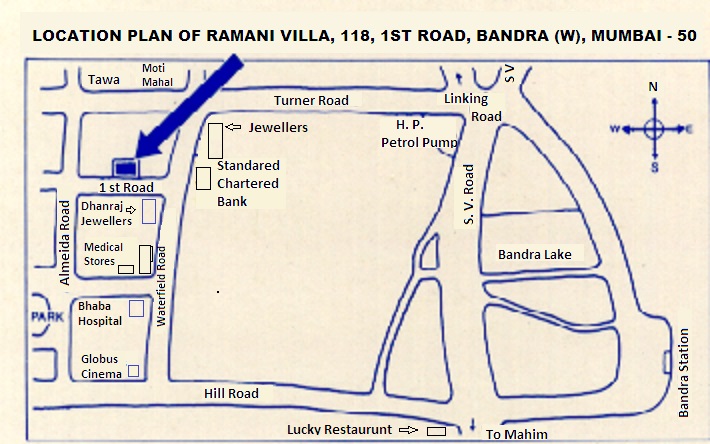
Plot No. 118, Ramani Villa, 1st Road, TPS IV,
Near Standard Chartered Bank, Bandra (W),
Mumbai - 400 050
Tel: +91 - 22 - 26516611, 26516614, Fax: +91 - 22 - 26404702 Email: kkrco@ramanilegal.com,
 |
